More than a diagnosis: Listen to the person without judgement
Trishanya noticed that she was experiencing significant anxiety related to her work. On a couple of occasions, she also had panic attacks before giving a presentation. She hesitated to share what she was going through with her colleagues because she had recently overheard them ridicule a co-worker struggling with depression. Instead of empathising with her, they discussed why she had been hired in the first place and described her as a burden. Trishanya was also worried that her anxiety might affect her chances of promotion. Does this scenario sound familiar?
The World Health Organization estimates that more than one billion people globally live with a mental health condition, highlighting the enormous scale of the challenge. At the same time, substantial gaps exist between the need for mental healthcare and the services available. Every year, World Mental Health Day is observed on 10th October to raise awareness, reduce stigma, and improve access to mental health care. The theme for this year's World Mental Health Day is "Lived experiences heard: real voices, real change"
Imagine telling someone, "I don't feel like myself these days, I am worrying a lot," and instead of being heard, you are told, "Everyone has problems. Just be strong." For someone struggling with depression, anxiety, bipolar disorder or other mental health condition, such responses can make an already difficult experience even harder.
We often talk about mental health in terms of symptoms, diagnosis and treatment. But behind every diagnosis is a person and a story. Two people with the same diagnosis can have very different journeys because mental health is influenced by family relationships, education, employment, financial circumstances, social support, culture and the environment in which a person lives.
A young professional with depression might continue going to work every day while struggling to get out of bed each morning. A student who appears confident may actually be dealing with severe anxiety.
Someone who has lived with depression knows what it feels like to lose interest in things they once enjoyed or to feel exhausted most of the time. Someone who has experienced anxiety knows how difficult it can be to face situations that others take for granted. Someone living with addiction knows what it feels like to be judged or viewed negatively by society.
People who have lived through mental illness know what it feels like to seek help, to wait for an appointment with a psychiatrist, to explain their symptoms, to take medication, to experience side effects, to apply medical leave, to face stigma, or sometimes, be unable to access treatment at all. Their perspectives can identify problems that may not be obvious from clinical guidelines or statistics.
Listening should lead to change. A person's lived experience should make us ask: Are mental health services accessible? Is treatment respectful? Do families receive adequate support? Does stigma prevent people from seeking help? What else can be done?
Behind every diagnosis is a person and a story.
Families and caregivers need a voice too.
Mental illness rarely affects only one individual. Families and caregivers often provide enormous emotional, financial and practical support. They may accompany the patient to appointments, monitor medication, manage crises, cope with behavioural changes and continue supporting recovery over several months or years. Caregivers themselves can become exhausted, isolated, anxious or overwhelmed. Listening to their experiences is therefore also an important component of compassionate mental healthcare. It is essential to support both patients and their caregivers.
What we can do?
We can ask ourselves a simple question: When someone talks about their mental health, do we listen or do we judge?
We can choose to be the person who makes it easier for someone to reach out and seek help.
We can encourage people to approach psychiatrists and receive timely care.
We can treat mental illness with the same seriousness and compassion as physical illness.
We can support people in recovery, rather than stigmatizing them or defining them by their diagnosis.
We can refrain from joking about psychiatric disorders and treat mental health conditions with the sensitivity they deserve.
And we can support a mental health system in which the experiences of patients and their families are taken seriously when healthcare services, schools, workplaces and public policies are planned.
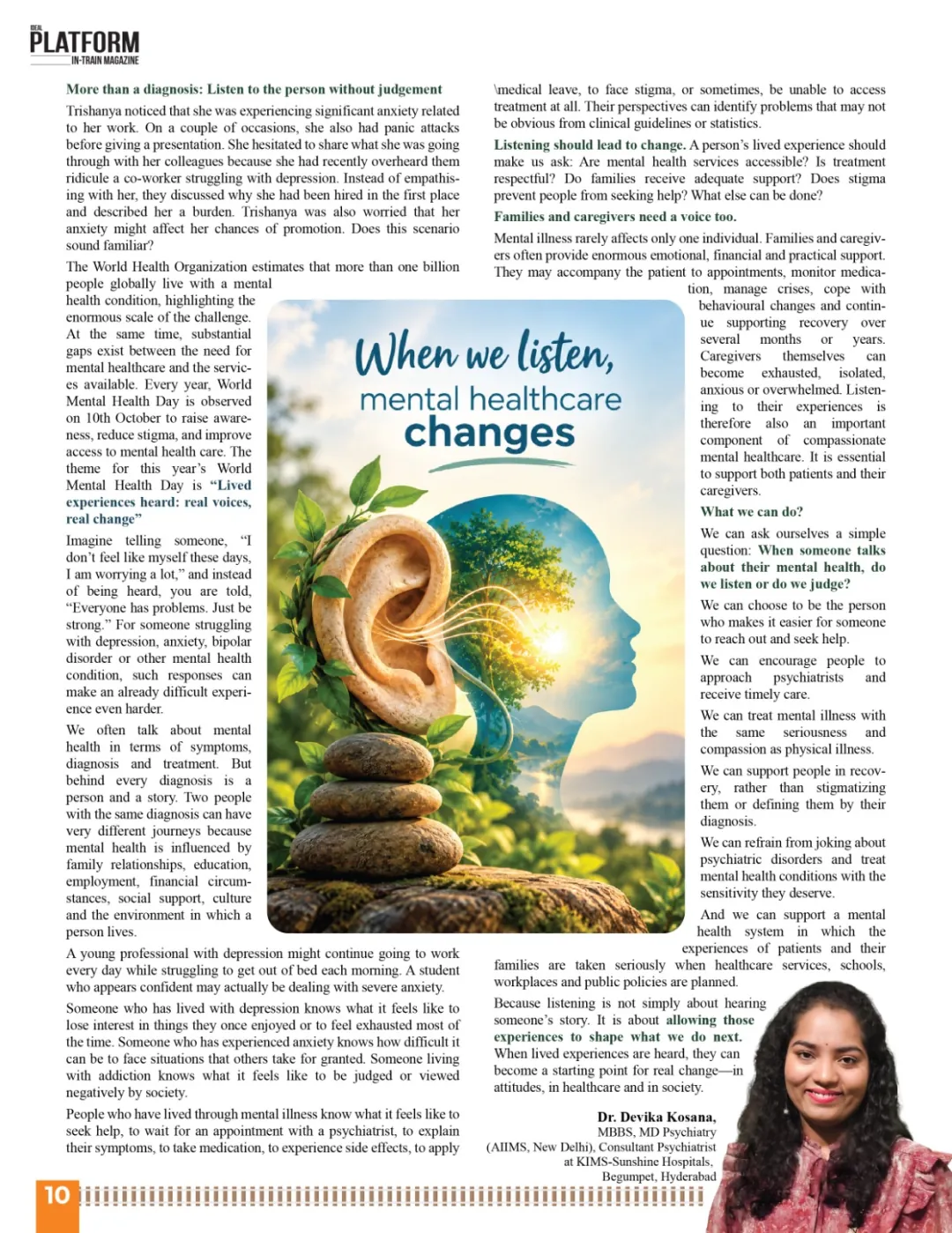
Because listening is not simply about hearing someone's story. It is about allowing those experiences to shape what we do next. When lived experiences are heard, they can become a starting point for real change—in attitudes, in healthcare and in society.
First published in Ideal Platform in-train magazine, October issue. Reproduced with the permission of the publisher. Printing errors have been corrected for the web; the wording is otherwise as published.