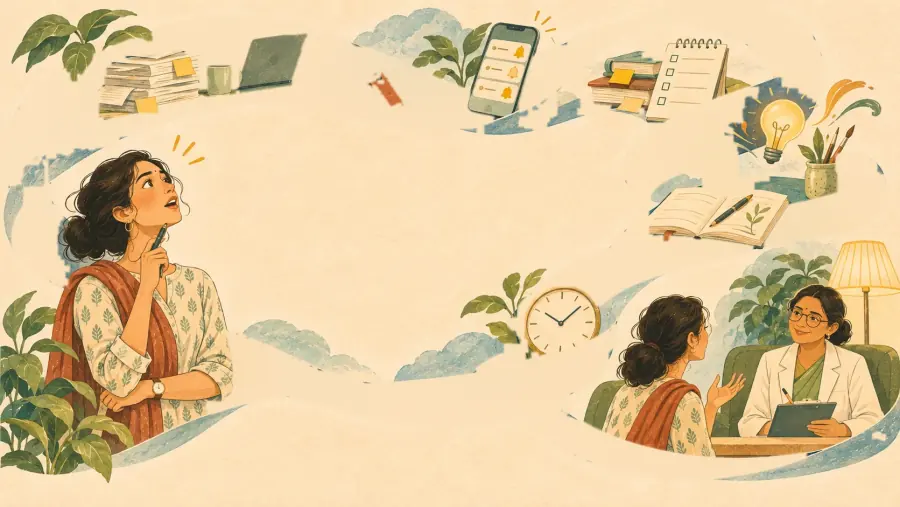
Yes, adults can have ADHD (attention-deficit/hyperactivity disorder). It begins in childhood and can continue through life, but some people only recognise it years later, sometimes when the demands of work, study or family grow.
If a video or online quiz made you wonder about yourself, that is a fair reason to ask a doctor. It is not a diagnosis. Trouble with attention is common and has many possible causes, and an assessment exists to find out which one fits you. If you are overwhelmed or having thoughts of harming yourself, call Tele-MANAS on 14416 (free, 24 hours).
How does ADHD look in adults?
In adults, ADHD often looks less like running around and more like trouble with attention and organisation, along with a feeling of restlessness inside.
- Attention and organisation: getting easily distracted, being forgetful, losing things such as keys, wallets or phones, making mistakes at work, and leaving tasks unfinished.
- Restlessness: finding it hard to relax, fidgeting, talking a lot, or being on the go all the time.
- Impulsivity: interrupting, impatience, acting without thinking, or spending on impulse.
Everyone has days like this, so these points are not a test. What counts for a diagnosis is the pattern: difficulties that began in childhood, have lasted, and cause significant problems in at least two areas of life, such as work, home or relationships.
Why might ADHD go unnoticed until adulthood?
ADHD can go unnoticed because some of its signs are quiet, and because people learn to hide them.
- Inattention can be harder to spot than hyperactivity, and not all symptoms are obvious to other people.
- ADHD is thought to be under-recognised in girls and women. NICE, the UK guideline body, notes that they are less likely to be referred and may be given a different diagnosis instead.
- Many people develop ways of hiding their symptoms, and this can be exhausting.
- Some people do not run into difficulties until adulthood, when responsibilities such as parenthood add to the demands on them.
Never having been diagnosed as a child does not rule out ADHD. But the difficulties should trace back to childhood, so concentration problems that started recently usually point a doctor towards other causes.
What does a proper ADHD assessment involve?
A proper assessment is a detailed conversation about your whole life with a doctor trained in ADHD, such as a psychiatrist. NICE advises that only a specialist with training and expertise in ADHD should make the diagnosis, based on a full clinical assessment, your developmental and psychiatric history, and reports from others.
A psychiatrist will usually cover these areas:
- Your childhood. Symptoms usually start before 12, so you will be asked about home and school. Old school reports can help if you still have them.
- Your life now. Work, study, relationships and daily routines show how much the difficulties affect you, and whether they appear in more than one setting.
- Someone who knows you. With your agreement, a parent, spouse or sibling may be asked what they have seen, because your own memories may be incomplete.
- Your health. Mental and physical health, medicines, and alcohol or drug use are all reviewed, because each can matter for diagnosis and treatment.
There is no blood test, brain scan or computer test that can diagnose ADHD on its own. It may help to read what happens at a first visit before you go.
A checklist or online quiz can raise the question, but only a full clinical assessment can answer it.
Why is a checklist or online quiz not a diagnosis?
A checklist or quiz can only record what you tick, and it cannot tell why those things are happening.
Questionnaires can help a doctor, and rating scales are useful added tools. But the Royal College of Psychiatrists says ADHD can only be accurately diagnosed through a comprehensive interview and a consultation-based assessment, and NICE says a diagnosis should not rest on rating scales alone.
A quiz cannot check when your difficulties began, whether they show up across your life, or how much they affect you. It cannot rule out the other conditions below either. Online information can also be inaccurate or misleading, so take what you have read to your appointment and ask about it.
What else can look like ADHD?
Several common conditions can affect concentration, memory or restlessness, and some can occur alongside ADHD.
- Anxiety and depression. The guides to overthinking and anxiety and depression explain more.
- Bipolar disorder, sleep disorders, and alcohol or drug use.
- Autism, Tourette’s syndrome, and learning difficulties such as dyslexia.
A psychiatrist tells these apart by asking when the difficulties began and how they have behaved over the years, since ADHD tends to be long-standing rather than starting in adult life. More than one condition can be present, and each may need its own treatment.
How is ADHD in adults treated?
Treatment usually combines learning about ADHD, practical changes and, for some people, therapy or medicine. The Indian Psychiatric Society’s 2019 ADHD guideline covers people up to 18 and says it may not apply to adults, so the points below draw on UK and European guidance.
- Understanding ADHD. Learning about the condition, ideally with your partner or family, is often the first step.
- Practical changes. Changes to your routine and workplace can help.
- Psychological support. CBT and coaching can help with organisation, time management and managing emotions.
- Medicine. ADHD medicines fall into two groups, stimulants and non-stimulants. NICE suggests offering medicine if symptoms still cause significant problems after practical changes have been made and reviewed. Not everyone needs or wants it.
A specialist starts and monitors ADHD medicine, after reviewing your mental and physical health, including your heart, pulse, blood pressure and weight. Never take a stimulant prescribed for someone else.
India’s Telemedicine Practice Guidelines 2020 bar doctors from prescribing certain medicines through telemedicine: those in Schedule X of the drug rules, and narcotic and psychotropic substances listed under the Narcotic Drugs and Psychotropic Substances Act, 1985. Telepsychiatry guidance from the Indian Psychiatric Society, the Telemedicine Society of India and NIMHANS places stimulant medicine for ADHD in this prohibited group, so it cannot be prescribed through a video, phone or text consultation. Other ADHD medicines fall under different rules, and rules can change, so ask your doctor what applies to you.
Sources
- Telemedicine Practice Guidelines (25 March 2020) · Board of Governors in supersession of the Medical Council of India, with NITI Aayog
- Telepsychiatry Operational Guidelines 2020 · Indian Psychiatric Society, Telemedicine Society of India and NIMHANS
- Clinical Practice Guidelines for the Assessment and Management of Attention-Deficit/Hyperactivity Disorder (2019) · Indian Psychiatric Society (Indian Journal of Psychiatry, via PMC)
- Attention deficit hyperactivity disorder: diagnosis and management (NG87) · National Institute for Health and Care Excellence (NICE)
- ADHD in adults · NHS
- ADHD in adults · Royal College of Psychiatrists
- European consensus statement on diagnosis and treatment of adult ADHD: The European Network Adult ADHD (2010) · BMC Psychiatry (via PMC)
General information only, not a substitute for a consultation.